

Our Legacy
Twin Oaks Country Club was just a gleam in the individual eyes of a dozen men one June night in 1955 when they first gathered in the lobby of the City Utilities building on Central Street.
That first meeting was a sort of person-to-person undertaking with Jim Robinett, Dean Miller and “Doc” Seabough passing the word around among men they thought might be interested in forming a new club. Thus, when the meeting settled down to its first serious discussion, those three had been joined by such others as Willard Graff, J. B. (Cap) Kidd, C.W. Johnson, Dick Smith, Merrill Dubach, Jim Rundell, Marvin Castleberry and Dick Stahl.
There were problems that appeared to be insurmountable—most of them relating to money—during those early meetings. Among the very first things discovered, however, was that Fred Morriset, who owned a farm overlooking what was later to become Lake Springfield, had been toying with the golf course idea himself and Dr. Jack Hume had been leading a campaign to promote a swimming club. It was natural then that Morriset and Hume be enlisted in the cause.
The first actual word of the country club project to reach the public at large was contained in a Springfield News and Leader editorial column on July 10, 1955, in which it was revealed that formation of a club was actually under way and it was to be located on the Morriset farm.
From that moment there was a rush of volunteers, all of whom were potential members, some of which proposed other lands on which a club could be located. In the end, there were no fewer than 18 sites proposed. Meanwhile, the club’s initial leaders had begun the circulation of “petitions” upon which prospective members were to fix their signatures. By the end of July, 190 names had been secured and by mid-September the total had topped 350. It was then time to call a mass meeting of those who professed to be interested, but rather than attempt to assemble all the applicants, a special invitation went out to every sixth name among the first 240 people, to attend a meeting at the Kentwood Arms. An outline of the financing plan that had been decided upon by the 12-man steering committee was to be discussed with the attendees.
Concluding the meeting, two final decisions had been reached: the club would be located on the 178 acre Art Johnson farm on Highway M, a short distance west of Fremont Street and the name of “Twin Oaks” had been adopted— even though closer examination disclosed there wasn’t a single oak tree on the premises.
Since September 18, Cap Kidd had worn the formal title of “manager” of the new club. It was his task to keep the books in order and to collect the initial payments—$60 if the new member wanted to go along on the $660 easy payment plan or $600 if he wanted to pay one lump sum. By mid-November, 310 persons—an agreed upon total for a closed membership—had affiliated the club and papers of Incorporation of Twin Oaks Country Club had been dispatched to Jefferson City.
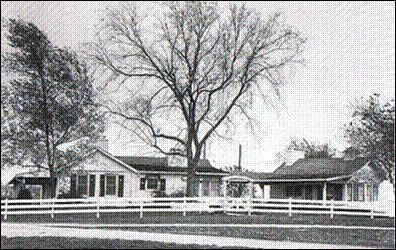
On December 8, 1955 formal purchase of the Art Johnson farm was achieved, a deal that was especially favorable to the club through the graciousness of Mr. Johnson’s Widow and of Ralph Foster. Mr. Johnson, before his death, said he never wanted the farm broken up into a real estate development; Mrs. Johnson and Mr. Foster expressed the feeling that a country club would ideally fulfill those desires.
Twin Oaks was now in business. A board of directors had been elected by the membership and under terms of the club’s charter, the four men receiving the highest total of votes were to be declared elected for a three-year term, the next four men for two years and the next four for one year. Thereafter four vacancies were to be filled by membership ballot each year.
Membership of the first board was made up of these men: H. Dean Miller, Carl R. Johnson, Jim Robinett and Willard Graff, three year terms, C.W. Johnson, Ransom Ellis, Dr. Jack Hume and J. B. Kidd, Two Year Terms; J. Warren Seabough, H. Garrett Wright, Leo E. Spradling and Richard P. Stahl, one-year terms. Dean Miller who had been selected by the original steering committee as interim president, was elected by the board to become the club’s first official president.
During that first year as a constituted club in 1956, conversion of the farmhouse to serve as a clubhouse began. Floyd Farley of Oklahoma City, one of the nation’s best-known golf architects, was employed to lay out the 18-hole course and to supervise immediate construction of the first nine holes. Even before a golf course was available for use, Gene Sallee was hired as head golf professional and Skeeter Lewis of Joplin as groundskeeper. The first actual employee of the club, however, was Wayne Parnell, hired as a caretaker when the club took possession of the Johnson farm and its fine old dwelling.
(Source: 1967 Twin Oaks Country Club Directory.)
